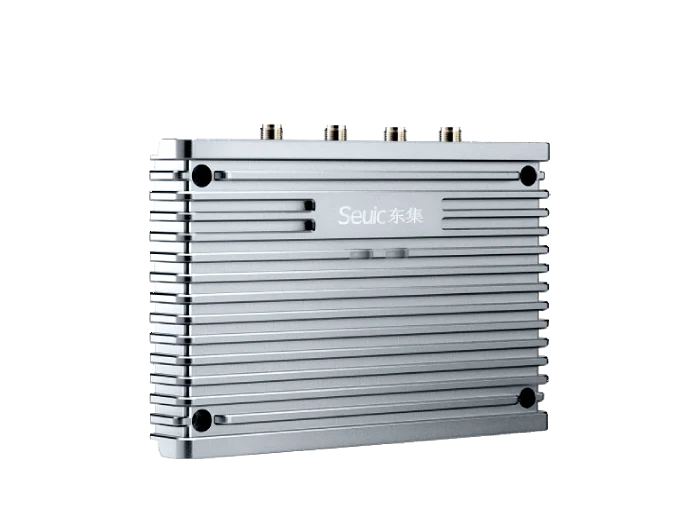
SEUIC (Dongji) / Fixed RFID readers
AUTOID UF3: Fixed RFID readers
SEUIC (Dongji) AUTOID UF3 is a four-channel fixed industrial UHF RFID reader for warehouse entry, exit and production-line automation. The official page lists an Impinj E710 engine, four antenna ports, RS232 and TCP/IP, isolated I/O, adjustable output and IP54 protection.
Suggested profiles: four-antenna warehouse, conveyor, production and fixed-point RFID systems
- RFID protocols
- EPC C1 Gen2, EPC Class1 Gen2X and ISO18000-6C
- Power
- 9-12 VDC; maximum current listed as 1.2 A; optional PoE requires confirmation
- Protection
- IP54
- Host communication
- RS232 and TCP/IP
- Frequency
- 860-960 MHz, adjustable for country or regional requirements
- RF output
- 5-30 dBm adjustable, with manufacturer tolerance of +/-1 dBm
The exact model, regional configuration and commercial terms require project confirmation.
Browse by device capability
AUTOID UF3 / Browse by device capability
UROVO is the primary established product resource, with SEUIC (Dongji) and selected platforms used where the capture method, form factor or deployment requirement needs another option. Published models follow an evidence, regional-configuration and RuggedLayer validation path.
Suggested profiles
- Warehouse receiving and dispatch points
- Conveyor or assembly-line RFID events
- Fixed asset and inventory stations with four antenna zones
Browse by device capability
- Four TNC antenna ports fit defined fixed RFID zones without requiring an eight-channel reader.
- Impinj E710, adjustable output, TCP/IP, RS232 and isolated I/O support automation integration.
- The manufacturer tag-rate reference is useful for initial sizing but does not establish line performance.
- RF layout, regional settings and trigger behavior remain part of the deployment design.
How a device enters the portfolio
Key specifications
Manufacturer-listed configuration; confirm the exact variant before ordering.
Platform
| Host communication | RS232 and TCP/IP |
|---|
Data capture
| RFID protocols | EPC C1 Gen2, EPC Class1 Gen2X and ISO18000-6C |
|---|---|
| RFID performance | More than 900 tags/s is stated by the manufacturer; target-tag and site behavior require testing |
Power and physical
| Antenna ports | Four TNC antenna interfaces |
|---|---|
| Power | 9-12 VDC; maximum current listed as 1.2 A; optional PoE requires confirmation |
Environmental
| Protection | IP54 |
|---|---|
| Environment | Operating -20 to +60 C; storage -25 to +80 C |
Other configuration
| Frequency | 860-960 MHz, adjustable for country or regional requirements |
|---|---|
| RF output | 5-30 dBm adjustable, with manufacturer tolerance of +/-1 dBm |
| I/O | Two optocoupler inputs and two optocoupler outputs |
| Status | Power and status indicators with buzzer |
| Physical | 230 x 156 x 30 mm |
A final shortlist depends on the application, scan or RFID workload, operating environment, country, deployment volume and support expectations.
A clear handoff at every layer
Five service layers for a more predictable device program.
RuggedLayer organizes access to multiple manufacturers into a consistent engagement model. Each layer has a defined input, deliverable and evidence boundary.
Service layers
- Define antenna placement, shielding, trigger logic, feeder length and read-zone boundaries with the machine owner.
- Confirm UHF frequency, output, power, optional PoE, GPIO voltage and TCP/IP or RS232 event contract.
- Pilot target tags, metal or liquid materials, movement speed, duplicates and stray reads before rollout.
Deployment accessories
- Scope four antennas, TNC cables, power or PoE, mounting hardware, enclosure and network or serial cabling.
- Keep the antenna map, RF profile, GPIO mapping, firmware and host retry policy in the station handover.
RuggedLayer Test Lab
Define a useful test, not a vague benchmark.
Tell us the labels, tags, application and operating conditions that matter.
- 01
Measure read, write, missed and stray events at each antenna zone with representative tags and materials.
- 02
Test trigger timing, antenna sequencing, protocol messages, duplicate suppression and power or network recovery.
- 03
Freeze the frequency, output, antenna layout, firmware, interface, accessories and acceptance limits.
Project intake
AUTOID UF3 / Start with enough context to make the next step useful.
Choose the closest project intent and describe only non-confidential workflow, application and deployment requirements.