AUX Group / Home-appliance manufacturing
MES-connected shop-floor data capture at AUX Group
Customer deployment reference / SEUIC (Dongji) hardware platform
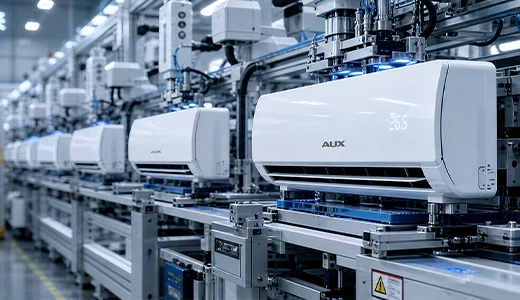
AUX Group used AUTOID Q9 Pro terminals as the shop-floor data-collection interface for production reporting, material movements, process tracking, quality inspection and warehouse inventory.
Case Studies
Design the mobile workflow before locking the device SKU.
Repeated barcode reads, short battery life and insufficient durability disrupted high-intensity, multi-shift production work.
Workflow solutions
Priority workflows
The AUTOID Q9 Pro connects to the MES workflow, combining a dedicated scanning engine with battery capacity intended to support continuous production data collection.
DevicesSEUIC AUTOID Q9 Pro industrial mobile terminal
Solution planning sequence
Solution planning sequence
A reliable deployment combines the right capture method, application behavior, connectivity, ergonomics, charging and replacement process. Solution design keeps those choices connected.
01 / Report production
Capture work events at the shop floor through the MES data-collection interface.
Moves reporting from delayed or repeated manual entry into the live production workflow.
02 / Track materials
Read materials during inbound and outbound movement.
Connects material status to production and warehouse decisions.
03 / Trace process and quality
Capture process-tracking and quality-inspection events.
Links the scanned item to its production and quality history.
04 / Support shifts
Use a device profile suited to high-intensity, multi-shift operation.
Avoids device battery and scan reliability becoming a line-side bottleneck.
Case Studies
Outcome-led scope
Solution pages will recommend capabilities first. Exact models remain replaceable until testing confirms the best fit.
Overall efficiency
More than 30% improvement after the production workflow was updated.
Shift continuity
Uninterrupted two-shift operation for high-intensity production.
Capture scope
Production reporting, materials, process tracking, quality inspection and warehouse inventory are included.
Engineering and supply services
Five service layers for a more predictable device program.
RuggedLayer organizes access to multiple manufacturers into a consistent engagement model. Each layer has a defined input, deliverable and evidence boundary. Hardware margin, validation, staging, project management and lifecycle support are distinct value streams. Scope and fees depend on the project.
Select
Production operators, material handlers, quality inspectors, warehouse teams and MES support.
Validate
Repeated barcode scans for production reporting, material movement, process steps, quality checks and inventory.
Deploy
MES, WMS or inventory service, quality records, work-order master data, identity and device management.
Commercial boundaries
Two-shift operation, high scan frequency, repeated labels, hard floors, battery continuity and shop-floor Wi-Fi.
A clear handoff at every layer
Five service layers for a more predictable device program.
Hardware margin, validation, staging, project management and lifecycle support are distinct value streams. Scope and fees depend on the project.
Operator application
Station-aware screens present the work order, material, operation, quality and exception actions needed at that point in production.
Commercial boundariesRuggedLayer maps the device workflow and validates the production application; the customer or MES owner controls routing and manufacturing rules.
Industrial capture layer
Rugged mobile or fixed capture is selected around code type, distance, surface, lighting, gloves, shift pattern and physical mounting or handling.
Commercial boundariesRuggedLayer owns the agreed device, scanner, accessory, configuration and sample-validation scope.
Plant connectivity
Plant Wi-Fi, private cellular or wired station links carry scan and process events with controlled retry and clear offline rules.
Commercial boundariesRuggedLayer validates device-side connectivity and application recovery; plant radio and server infrastructure remain customer-owned unless separately included.
MES, WMS and quality systems
Enterprise systems remain authoritative for work orders, bills of material, inventory, process history, nonconformance and quality release.
Commercial boundariesRuggedLayer reviews event payloads and integration behavior in scope; the system owner approves production transactions and exception rules.
Publication gate
Comparable device evidence with method, version and limitations.
The Test Lab defines what must be recorded before a manufacturer reference or RuggedLayer observation can support a purchase or deployment decision.
Publication gate
- 01
A repeated scan would create a duplicate production or movement event.
Detect the existing transaction key, show its status and prevent a second posting unless an authorized correction is opened.
- 02
Material, operation or quality status does not match the active work order.
Block completion and route the discrepancy to the responsible production or quality role.
- 03
Battery or device health will not cover the remaining shift.
Prompt an approved battery or device swap while preserving user and task state through managed handover.
How to read the references
MES events
Every approved reporting, movement, process and quality action reaches the correct order and item history once.
Scan reliability
The representative label set meets first-read and scan-to-screen targets under line-side handling.
Shift continuity
The approved power and spare-device plan completes the defined two-shift operating profile.
Quality control
Mismatch, duplicate, rework and inspection-failure routes preserve the correct block and audit record.
A clear handoff at every layer
Choose the first service layer.
A short requirement review will identify whether selection, validation or customization comes first.
01 / Discover
A station-by-station event map covering codes, surfaces, cycle time, MES ownership, operators, environment and rework paths.
02 / Line-side validation
Real samples tested at working distance, angle, lighting, gloves, scan frequency, network conditions and shift duration.
03 / Bounded production pilot
One line, station group or warehouse zone with baseline data, controlled fallbacks and production-owner sign-off.
04 / Standardize and deploy
Approved hardware and configuration, station or charging plan, enrollment package, operator training, spares and change control.
Enterprise device portfolio
Mobile computers, barcode scanners and RFID readers by workflow.
A final shortlist depends on the application, scan or RFID workload, operating environment, country, deployment volume and support expectations.

UROVO / Enterprise mobile computers
DT40
Keypad mobile-computer family for repeated industrial data capture.Devices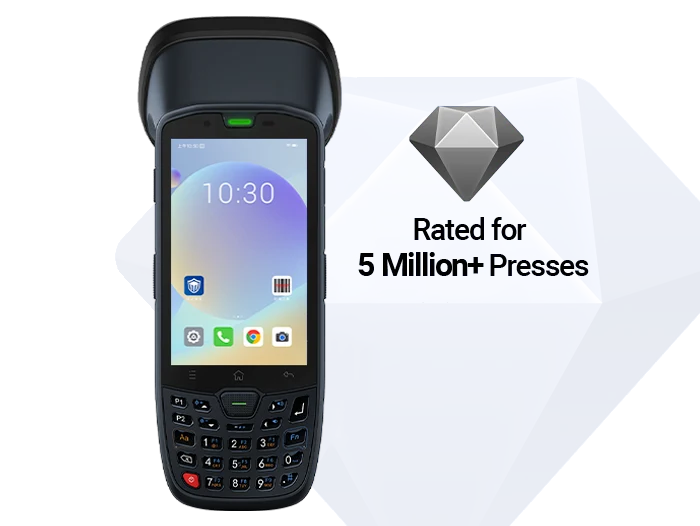
SEUIC (Dongji) / Keypad mobile terminals
AUTOID 10-DPM
DPM-oriented keypad terminal for demanding marked-code workflows.Devices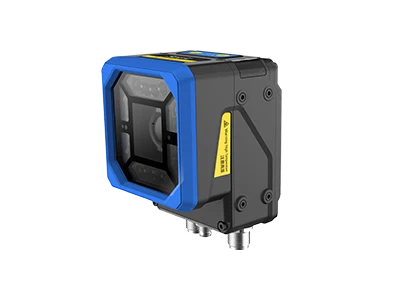
SEUIC (Dongji) / Visual readers
X5Pro
Visual reader option for code and inspection-oriented stations.DevicesProject intake
Project intake form
Submit the form to request a shortlist, validation plan, sample discussion or scoped OEM feasibility review. Restricted files require a separately agreed transfer method.